Technology continues to evolve at an extraordinary pace, shaping the way people live, work, and communicate. By 2026, digital transformation is expected to accelerate even further as new technologies emerge and existing innovations become more advanced and accessible. Businesses, governments, and individuals are increasingly relying on digital tools to improve efficiency, enhance communication, and create new opportunities for growth.
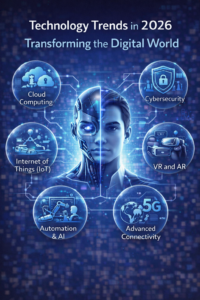
The digital world is being transformed by developments in artificial intelligence, cloud computing, automation, cybersecurity, and connectivity. These technological trends are not only improving productivity but also changing entire industries such as healthcare, education, finance, retail, and manufacturing. As organizations adopt smarter technologies, they are able to make better decisions, deliver improved services, and respond more effectively to changing market demands.
Understanding the key technology trends of 2026 is essential for businesses and professionals who want to stay competitive in the rapidly evolving digital landscape.
Table of Contents
ToggleArtificial Intelligence Becoming a Core Technology
Artificial Intelligence has moved beyond being an experimental technology and is now becoming a core component of modern digital systems. Businesses are using AI to analyze large volumes of data, automate processes, and improve customer experiences. Machine learning algorithms allow systems to learn from data patterns and make predictions that help organizations make informed decisions.
In 2026, AI is expected to be integrated into a wide range of applications, from smart assistants and automated customer service systems to advanced data analytics platforms. AI-powered tools can help companies identify trends, forecast demand, and optimize operations more efficiently than traditional methods.
The growth of AI is also supporting innovation in areas such as natural language processing, computer vision, and intelligent automation. These capabilities are enabling machines to understand human language, recognize images, and perform complex tasks that previously required human involvement.
Expansion of Cloud Computing and Hybrid Infrastructure
Cloud computing continues to play a vital role in digital transformation. Organizations are increasingly adopting cloud platforms to store data, run applications, and scale their operations without investing heavily in physical infrastructure. Cloud services provide flexibility, reliability, and cost efficiency, making them essential for modern businesses.
In 2026, hybrid and multi-cloud strategies are becoming more common. Many organizations combine private cloud systems with public cloud services to balance security, performance, and cost. This hybrid approach allows businesses to maintain control over sensitive data while benefiting from the scalability of public cloud environments.
Cloud platforms also support advanced technologies such as big data analytics, artificial intelligence, and remote collaboration tools. As businesses continue to digitize their operations, cloud computing will remain a key driver of innovation and efficiency.
Growth of the Internet of Things (IoT)
The Internet of Things refers to networks of connected devices that collect and exchange data through the internet. These devices include smart home appliances, wearable technology, industrial sensors, and connected vehicles. By 2026, the number of IoT devices worldwide is expected to grow significantly as organizations adopt smart technologies to improve automation and monitoring.
IoT technology allows businesses to gather real-time information about equipment performance, environmental conditions, and consumer behavior. This data can help organizations optimize operations, reduce costs, and improve decision-making.
In industries such as manufacturing and logistics, IoT devices enable predictive maintenance by identifying potential equipment failures before they occur. In smart cities, connected sensors help manage traffic, energy usage, and public services more efficiently.
Advancements in Cybersecurity Technologies
As digital technologies expand, cybersecurity has become one of the most critical concerns for organizations and governments. The growing number of connected systems increases the risk of cyber attacks, data breaches, and digital fraud. As a result, cybersecurity technologies are evolving rapidly to protect digital infrastructure and sensitive information.
Advanced security tools now use artificial intelligence and machine learning to detect unusual behavior and identify potential threats in real time. These systems analyze network activity and user behavior to recognize patterns associated with cyber attacks.
In 2026, organizations are expected to adopt stronger security strategies, including zero-trust security models, multi-factor authentication, and advanced encryption methods. These technologies help ensure that only authorized users can access sensitive systems and data.
Rise of Automation and Intelligent Systems
Automation is becoming an essential component of modern business operations. Organizations are using intelligent systems and robotic process automation to handle repetitive tasks, reduce human error, and increase productivity.
In 2026, automation technologies are expected to become more sophisticated, enabling machines to perform complex workflows that previously required human intervention. Businesses are integrating automation into areas such as supply chain management, customer service, financial operations, and manufacturing processes.
Intelligent automation systems combine artificial intelligence, machine learning, and data analytics to improve decision-making and efficiency. These technologies allow organizations to streamline operations while allowing employees to focus on more strategic and creative tasks.
Evolution of Virtual and Augmented Reality
Virtual Reality and Augmented Reality technologies are gaining popularity in both consumer and business environments. These immersive technologies allow users to interact with digital content in highly engaging ways.
In education and training, VR simulations provide realistic environments where students and professionals can practice skills safely. AR applications enhance real-world experiences by overlaying digital information onto physical surroundings.
By 2026, improvements in hardware, graphics processing, and connectivity are expected to make immersive technologies more accessible. Businesses are increasingly using VR and AR for product demonstrations, remote collaboration, training programs, and customer engagement.
Expansion of 5G and Advanced Connectivity
High-speed connectivity is essential for supporting modern digital technologies. The expansion of 5G networks is expected to significantly improve internet speed, reliability, and network capacity. These improvements enable faster data transmission and support technologies that require real-time communication.
With 5G connectivity, devices such as autonomous vehicles, smart city systems, and industrial automation platforms can operate more efficiently. Low-latency communication allows systems to respond instantly to changes in their environment.
The growth of advanced connectivity also supports emerging technologies such as augmented reality, remote healthcare services, and large-scale IoT networks. As 5G infrastructure continues to expand globally, it will play a major role in shaping the digital landscape of the future.
Importance of Digital Skills and Technology Education
As technology continues to evolve, the demand for digital skills is increasing across all industries. Professionals need to understand emerging technologies, data analytics, cybersecurity practices, and digital communication tools to remain competitive in the modern workforce.
Educational institutions and organizations are adapting their training programs to prepare individuals for technology-driven careers. Online learning platforms, virtual training environments, and digital certification programs are helping people acquire new technical skills more efficiently.
Developing a strong digital workforce is essential for supporting innovation and ensuring that organizations can successfully implement advanced technologies.
Conclusion
The technology trends emerging in 2026 are transforming the digital world in profound ways. Innovations in artificial intelligence, cloud computing, IoT, cybersecurity, automation, and connectivity are reshaping industries and redefining how people interact with technology.
These advancements are enabling businesses to improve efficiency, deliver better services, and create new opportunities for growth. At the same time, organizations must address challenges related to security, infrastructure, and workforce skills to fully benefit from digital transformation.
As technology continues to evolve, staying informed about emerging trends will be essential for individuals and organizations seeking to succeed in the rapidly changing digital landscape. The future of the digital world will be driven by innovation, collaboration, and the responsible use of advanced technologies.
