In recent years, artificial intelligence has advanced rapidly, and one of the most transformative developments has been the emergence of generative AI tools. These technologies are capable of producing new content such as text, images, audio, code, and videos based on patterns learned from vast datasets. As organizations adopt these tools across industries, generative AI is reshaping the way people work, create, and collaborate.
Generative AI is not only improving productivity but also expanding creative possibilities. Professionals in marketing, design, education, research, and software development are using AI-powered platforms to automate routine tasks and explore new ideas. By assisting humans rather than replacing them, generative AI is becoming a powerful partner in innovation and digital transformation.
Understanding how generative AI tools are influencing the future of work and creativity helps individuals and organizations prepare for the evolving digital economy.
Table of Contents
ToggleUnderstanding Generative AI and Its Capabilities
Generative AI refers to artificial intelligence systems designed to create original content rather than simply analyzing or classifying data. These systems are trained on large datasets that allow them to understand patterns in language, images, and other forms of information. As a result, they can generate new material that closely resembles human-created work.
Modern generative AI models can produce written articles, marketing content, digital artwork, music compositions, programming code, and even realistic video simulations. These capabilities have made AI tools highly valuable across industries that rely on creativity and communication.
The ability to generate content quickly allows professionals to focus more on strategic thinking, planning, and innovation while the AI handles repetitive or time-consuming tasks.
Transforming Content Creation and Digital Media
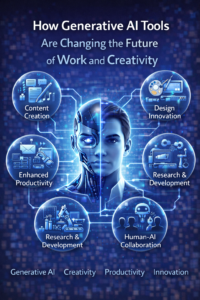
Generative AI tools are significantly transforming the content creation industry. Writers, marketers, designers, and social media professionals are increasingly using AI-powered tools to generate ideas, draft content, and create visual media.
These tools help streamline the content production process by assisting with brainstorming, drafting outlines, generating marketing copy, and producing creative visuals. For businesses that rely on regular content publishing, generative AI can dramatically reduce the time required to create high-quality materials.
However, while AI can support content creation, human creativity remains essential. Professionals still guide the overall message, tone, and strategy, ensuring that the final content aligns with brand identity and audience expectations.
Enhancing Productivity and Workplace Efficiency
One of the most significant impacts of generative AI is its ability to improve productivity across many types of jobs. Employees can use AI tools to automate repetitive tasks such as drafting emails, summarizing reports, generating presentations, or analyzing large amounts of information.
This automation allows workers to dedicate more time to problem-solving, innovation, and collaboration. Businesses benefit from faster workflows, improved efficiency, and reduced operational costs.
In industries such as customer service, marketing, research, and software development, generative AI is helping professionals work smarter rather than harder. By acting as a digital assistant, AI tools support decision-making and help teams complete tasks more efficiently.
Revolutionizing Design and Creative Industries
The design industry has experienced a major transformation due to generative AI technologies. Graphic designers, illustrators, video editors, and digital artists now have access to tools that can generate visual concepts, create artwork, and assist in design development.
These tools allow creatives to experiment with multiple ideas quickly and refine their designs faster than traditional methods. Instead of spending hours creating initial drafts, designers can generate several design options within minutes and focus on improving the final product.
Generative AI also enables collaboration between human creativity and machine intelligence. Designers provide creative direction and artistic judgment, while AI tools help execute ideas more efficiently.
Supporting Innovation in Research and Development
Generative AI is also playing a growing role in scientific research and product development. Researchers are using AI models to analyze large datasets, generate research summaries, and assist with hypothesis generation.
In fields such as medicine, engineering, and technology development, AI can simulate complex scenarios and generate insights that may help accelerate innovation. These capabilities allow researchers to explore possibilities more quickly and identify patterns that may not be easily visible through traditional analysis.
By assisting researchers in processing large volumes of information, generative AI helps improve the speed and efficiency of discovery in many scientific disciplines.
Changing the Skills Required for Future Jobs
As generative AI tools become more widely used, the skills required in the workplace are also evolving. Professionals are increasingly expected to understand how to work alongside AI technologies and use them effectively to improve productivity.
Skills such as critical thinking, creativity, problem-solving, and strategic planning are becoming even more valuable. While AI can generate content and automate processes, human judgment and decision-making remain essential for guiding these technologies.
Many organizations are investing in digital training programs to help employees learn how to use AI tools responsibly and effectively. Understanding AI capabilities and limitations will be an important part of future career development.
Ethical and Responsible Use of Generative AI
Despite its many advantages, generative AI also raises important ethical and regulatory concerns. Issues such as misinformation, copyright ownership, and data privacy must be carefully addressed as AI-generated content becomes more widespread.
There is also concern about the potential misuse of generative AI for creating misleading information or manipulated media. To address these challenges, governments, technology companies, and researchers are working to develop guidelines and policies that ensure responsible AI use.
Organizations adopting generative AI technologies must implement clear ethical standards, maintain transparency, and ensure that AI-generated content is used responsibly.
The Future of Collaboration Between Humans and AI
The future of work is likely to involve close collaboration between humans and intelligent machines. Rather than replacing human workers, generative AI tools are expected to act as supportive partners that enhance human capabilities.
Professionals will use AI tools to handle repetitive tasks, analyze information, and generate creative suggestions. Humans will continue to provide creativity, strategic thinking, emotional intelligence, and ethical judgment.
This collaborative approach allows organizations to combine the strengths of human expertise with the efficiency of advanced technology, creating more innovative and productive workplaces.
Conclusion
Generative AI tools are transforming the future of work and creativity in remarkable ways. By enabling machines to generate text, images, code, and other forms of content, these technologies are helping professionals complete tasks more efficiently and explore new creative possibilities.
While generative AI offers significant benefits, it also requires thoughtful implementation and responsible use. Organizations must ensure that these technologies are used ethically while also investing in the skills needed for the evolving digital workforce.
As technology continues to advance, the collaboration between human creativity and artificial intelligence will play a crucial role in shaping the future of innovation, productivity, and digital transformation across industries.
