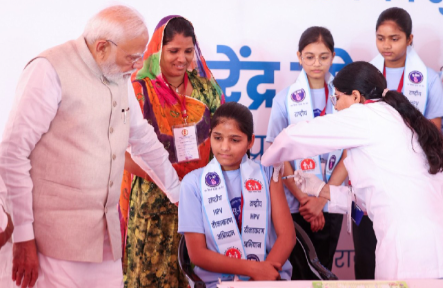
In a landmark public health intervention, Prime Minister Narendra Modi formally launched a nationwide Human Papillomavirus (HPV) vaccination campaign for 14‑year‑old girls from Ajmer, Rajasthan — a move that marks a decisive shift in India’s approach to women’s health and cancer prevention. This ambitious programme aims to prevent cervical cancer at its source by providing a free, voluntary, single‑dose HPV vaccine to girls across the country. With an estimated 1.15–1.2 crore girls targeted annually under the campaign, the initiative represents one of the most significant preventive healthcare efforts in India’s recent history.
The Rationale Behind the HPV Vaccination Drive
Cervical cancer is one of the leading causes of cancer‑related deaths among women in India. Persistent infection with high‑risk types of Human Papillomavirus (HPV) — particularly types 16 and 18 — accounts for the overwhelming majority of cervical cancer cases. These cancer‑causing HPV strains can remain asymptomatic for years, making early intervention critical. The HPV vaccine protects against these high‑risk types as well as low‑risk types that cause genital warts, offering broad protection when administered before exposure to the virus.
Historically, HPV vaccines were available in India only through private healthcare channels, limiting access due to cost and uneven implementation. With this nationwide campaign, the government has introduced a single‑dose quadrivalent vaccine into the Universal Immunisation Programme (UIP), making it accessible to all eligible girls at government health facilities free of cost.
A Nationwide Effort from Ajmer to Every State
The nationwide rollout was inaugurated during a public event in Ajmer, where Prime Minister Modi emphasised the need to prioritise preventive healthcare and safeguard the well‑being of young girls. Under the programme:
-
Girls aged 14 years are eligible to receive the single‑dose HPV vaccine each year across all Indian states and Union Territories.
-
The vaccine is administered voluntarily with parental or guardian consent, ensuring informed participation.
-
Government health facilities — including Primary Health Centres, Community Health Centres, sub‑district and district hospitals, and medical colleges — serve as vaccination sites, supported by trained healthcare professionals.
-
The programme is integrated with functional cold chain systems and observation setups to monitor and manage potential side effects.
By embedding the vaccination campaign within the existing health infrastructure, the government aims to achieve universal and equitable coverage, reaching girls in both urban and rural settings.
The Science and Benefits of HPV Vaccination
Vaccination against HPV before exposure to the virus provides significant long‑term protection. Clinical evidence has shown that the single‑dose HPV vaccine offers high efficacy — comparable to multi‑dose regimens — against persistent infections by HPV types that cause most cervical cancers. When administered at age 14, the vaccine can dramatically reduce the lifetime risk of developing cervical cancer. Early immunisation also reduces the burden of pre‑cancerous lesions that would otherwise require medical intervention later in life.
By focusing on girls before they reach adulthood, the programme aligns with global cancer prevention strategies that emphasise early, pre‑exposure immunisation to maximise protective impact.
A Focus on Prevention and Long‑Term Health
The drive represents a broader paradigm shift in India’s health policy — from curative care towards preventive healthcare. Historically, much of the focus in cancer care has been on detection and treatment after disease onset. By contrast, the HPV vaccination initiative tackles the root cause of cervical cancer, aiming to lower incidence and mortality over the long term.
Experts argue that widespread vaccination could dramatically reduce India’s cervical cancer burden — which claims tens of thousands of lives each year — and align the country with global targets set by health authorities for elimination of cervical cancer as a public health problem. Early childhood vaccination and routine screening are key components of these global strategies.
State‑Level Implementation and Local Initiatives
Following the national launch, several states and local administrations have quickly mobilised to implement the campaign:
-
Nagaland launched its free HPV vaccination drive at state level, aiming to cover all eligible girls aged 14 across government facilities.
-
Telangana reported its own rollout where the first beneficiaries received the vaccine, highlighting local commitment to the national goal.
-
Odisha inaugurated its statewide campaign, targeting over 3.36 lakh girls aged 14–15 in a structured three‑month campaign.
-
Delhi began its phase with 1.6 lakh girls receiving free single‑dose vaccinations under the larger national effort.
-
Similar drives, often framed as part of routine immunisation outreach, have begun in other districts and municipalities, reflecting widespread uptake across India.
These state efforts underscore how central policy is translating into action at the grassroots, ensuring that the campaign’s benefits reach diverse communities nationwide.
Overcoming Social Barriers and Ensuring Participation
Despite strong scientific backing and official support, public communication remains a critical component. As with all vaccination efforts, misinformation and social scepticism can pose challenges to uptake. Health authorities and medical professionals are actively engaging communities, dispelling myths about vaccine safety and emphasising the protective benefits for long‑term health.
Education campaigns encourage parents and guardians to understand that the HPV vaccine is safe, effective, and an essential tool in preventing a cancer that predominantly affects women. By fostering trust and awareness, public health officials aim to ensure high participation rates and sustained momentum for the campaign.
Economic and Health System Impacts
The nationwide rollout also carries economic implications. Including HPV vaccination in the UIP creates a predictable government procurement market for vaccines, estimated to translate to significant annual vaccine volumes and stable procurement demand. This supports not only public health goals but also domestic vaccine production and health market investment, creating a sustainable long‑term ecosystem for preventive care.
By focusing government resources on preventive measures, the initiative aims to reduce future healthcare costs associated with treating advanced cervical cancer and its complications — a strategy that benefits families and the healthcare system alike.
A Future Vision: Eliminating Cervical Cancer
The HPV vaccination campaign represents a bold step towards eliminating cervical cancer in India. While no single intervention can completely wipe out a disease, the cumulative impact of early vaccination, routine screening, and public awareness can transform the nation’s health profile over generations. This programme empowers young girls and their families with protection at a crucial stage of life, helping ensure healthier futures and reducing the burden of one of the most preventable cancers.
Conclusion
India’s nationwide HPV vaccination drive for 14‑year‑old girls marks a historic public health milestone. By providing a free, voluntary, single‑dose vaccine to over one crore eligible girls annually, the campaign sets a new benchmark for preventive healthcare and women’s health equity. The multi‑state rollout, combined with robust awareness efforts and integration within existing health systems, positions India to make significant progress in its fight against cervical cancer. As this initiative unfolds across the country, it may well redefine how preventable cancers are tackled, demonstrating the power of early intervention in achieving long‑term health goals.
Read More at: recchiabegue.com
