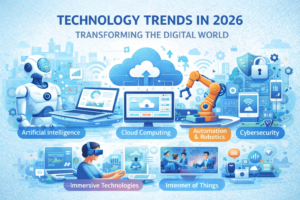
Technology continues to evolve rapidly, reshaping industries, economies, and everyday life. By 2026, emerging innovations are expected to significantly transform how businesses operate, how people communicate, and how societies function. Advancements in artificial intelligence, cloud computing, automation, cybersecurity, and immersive technologies are creating new opportunities while also presenting new challenges. Organizations across the world are investing heavily in digital transformation to remain competitive in a technology-driven environment. These developments are not only improving efficiency but also enabling smarter decision-making and more personalized digital experiences. Understanding the major technology trends of 2026 helps businesses and individuals prepare for a future where digital systems are deeply integrated into nearly every aspect of life.
Artificial Intelligence Becoming More Integrated
Artificial intelligence (AI) continues to be one of the most influential technologies shaping the digital world. By 2026, AI is expected to become deeply embedded in business operations, consumer applications, and industrial systems. Organizations are increasingly using AI to analyze massive datasets, automate processes, and generate insights that improve decision-making. Machine learning models are also becoming more advanced, allowing companies to predict market trends, detect fraud, and personalize customer experiences.
In addition, AI-powered tools are enhancing productivity in sectors such as healthcare, finance, education, and manufacturing. For example, businesses are using AI-driven chatbots for customer support, while healthcare professionals rely on AI to assist with medical imaging and diagnostics. As AI technologies mature, companies are focusing more on responsible AI practices, ensuring transparency, fairness, and data privacy. The integration of AI into everyday systems will continue to expand, making it a central component of digital transformation strategies.
Growth of Cloud Computing and Hybrid Infrastructure
Cloud computing has become the backbone of modern digital infrastructure, and its importance will continue to grow in 2026. Businesses are increasingly moving their applications, data storage, and development platforms to cloud environments because they offer scalability, flexibility, and cost efficiency. Cloud technology allows organizations to operate without relying heavily on physical hardware, enabling teams to collaborate and access information from anywhere.
Another significant trend is the rise of hybrid and multi-cloud environments. Many organizations now combine private and public cloud services to balance security, performance, and cost. This approach allows businesses to store sensitive information in private cloud systems while using public cloud platforms for scalable computing power. Cloud service providers are also investing in advanced data analytics, automation, and artificial intelligence tools integrated into their platforms. As remote work and global digital collaboration continue to expand, cloud computing will remain a crucial foundation for modern business operations.
Expansion of Automation and Robotics
Automation and robotics are transforming industries by increasing efficiency and reducing manual workloads. By 2026, businesses are expected to adopt more intelligent automation systems that combine robotics, AI, and machine learning. These systems can perform repetitive tasks with greater speed and accuracy than human workers, allowing employees to focus on strategic and creative activities.
In manufacturing, robotics is improving production efficiency through automated assembly lines and precision engineering. Logistics and supply chain industries are also implementing automation technologies such as autonomous warehouses and delivery systems. Even in service sectors, robotic process automation is being used to streamline administrative tasks, data entry, and financial processes.
While automation raises concerns about job displacement, it also creates new opportunities for skilled professionals who design, manage, and maintain these systems. As companies continue to integrate automation into their workflows, workforce training and digital skills development will become increasingly important.
Advancements in Cybersecurity and Data Protection
As digital technologies expand, cybersecurity has become a top priority for businesses and governments worldwide. By 2026, the increasing number of connected devices and digital services will create more potential entry points for cyber threats. As a result, organizations are investing heavily in advanced security solutions to protect sensitive data and maintain trust with customers.
Modern cybersecurity strategies focus on proactive threat detection, artificial intelligence-based monitoring, and zero-trust security frameworks. These systems continuously analyze network activity and identify suspicious behavior before it causes damage. Encryption technologies and secure authentication methods are also becoming more sophisticated to prevent unauthorized access.
In addition, regulatory requirements related to data protection are becoming stricter across many countries. Businesses must ensure compliance with privacy regulations while implementing strong cybersecurity measures. The combination of advanced technologies and regulatory frameworks will play a critical role in protecting digital ecosystems in the coming years.
Rise of Immersive Technologies: AR, VR, and the Metaverse
Immersive technologies such as augmented reality (AR), virtual reality (VR), and the evolving concept of the metaverse are transforming how people interact with digital environments. By 2026, these technologies are expected to become more accessible and widely used across various industries. AR overlays digital information onto the real world, while VR creates fully immersive virtual environments.
Businesses are using AR and VR for training simulations, product demonstrations, and remote collaboration. For example, companies can train employees in realistic virtual environments without the risks associated with physical training scenarios. In retail, AR applications allow customers to visualize products before purchasing them.
The concept of the metaverse, a shared virtual space where users interact through digital avatars, is also gaining attention. Although still evolving, the metaverse could reshape online communication, entertainment, and commerce. As hardware and software technologies improve, immersive digital experiences will become an increasingly important part of the digital economy.
Internet of Things and Smart Connectivity
The Internet of Things (IoT) refers to networks of connected devices that collect and exchange data through the internet. By 2026, billions of IoT devices are expected to be in use worldwide, ranging from smart home appliances to industrial sensors. These devices enable real-time data monitoring, helping organizations improve efficiency and reduce operational costs.
In smart cities, IoT technologies are used to manage traffic systems, monitor energy consumption, and improve public services. In healthcare, connected medical devices allow doctors to track patient health remotely and provide timely interventions. Industrial IoT applications also help manufacturers monitor equipment performance and predict maintenance needs before failures occur.
However, the rapid expansion of IoT devices also increases cybersecurity challenges. Businesses must implement strong security protocols to protect connected systems from potential cyber threats. As connectivity technologies continue to evolve, IoT will remain a critical component of digital transformation initiatives.
Conclusion
The technology landscape in 2026 will be shaped by rapid innovation and increasing digital integration across industries. Artificial intelligence, cloud computing, automation, cybersecurity, immersive technologies, and the Internet of Things are collectively transforming how businesses operate and how people interact with technology. These advancements are driving efficiency, enabling new business models, and creating more personalized digital experiences.
At the same time, organizations must address challenges related to data privacy, cybersecurity, and workforce adaptation. Businesses that successfully embrace emerging technologies while maintaining ethical and responsible practices will be better positioned to thrive in the evolving digital economy. As technology continues to advance, staying informed about these trends will be essential for companies and individuals seeking to navigate the future of the digital world.
Read more : recchiabegue.com
